
Reflection on Filter Bubbles and Surveillance Capitalism
One of the things that struck me in this module was that as soon as we began to talk about filter bubbles, was the familiarity of the concept to me. I realised that I had been talking about this in classrooms for years without having the terminology for it – even writing about it in the school yearbook a number of years ago. I have always referred to this phenomenon as the ‘Google algorithm.’ What this has meant to me in my teaching was that I was becoming increasingly aware that with the rise of the digital – particularly TV, gaming and smart phones, there has been an exponential decline in students’ general knowledge – the type of information we glean up from casual TV viewing and from reading books and newspapers. Students could no longer hazard a guess at what a metaphor which included the word ‘eyrie’ might mean– because they didn’t know that word; nor did they understand the significance of the title ‘Living in Sin’; they only recognised the term ‘Big Brother’, from the reality TV show, with someone guessing that maybe it was a originally an app! The rise in information technology is at least somewhat to blame for this. Years ago, we acquired general knowledge by being forced to sit through whatever our parents were watching from the limited range of programmes available, from reading and from discussion. The result was we had some working knowledge of the world around us, but it seems that for the current generation, the very devices which we believe contain infinite knowledge may actually be making us less smart. (Carr, 2008)
In the years since Eli Pariser began to speak about filter bubbles as a concept, others have studied the phenomena, with the broad conclusion being that evidence can be found to support both the hypotheses that our data trail and online choices can broaden and widen our horizons in some ways, and narrow them in others. (Chitra and Musco, 2020), (Flaxman et al., 2016). Much of what has been studied has focused on America on the impact of filter bubbles on partisanism, but findings are applicable to other contexts. Because of filter bubbles and echo chambers and algorithms, people increasingly lack a broad world view. While we consider that the world now is more advanced and more open than ever, the impact of filter bubbles and data tracking may mean that much of what we are fed is based largely on what we already know or believe to be true. We are becoming experts in the narrow fields of our own interest. Beyond even general knowledge, this suggests a lack of worldliness, resourcefulness, and awareness of how things work today.
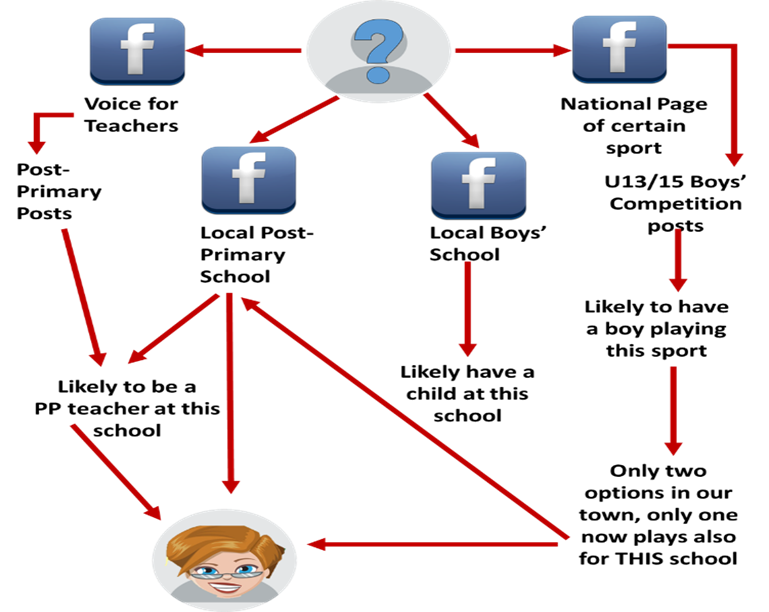
I do not ‘do social media’, I’m invisible online – that’s what I tell myself – I have an obscure Twitter handle from which I never tweet, a private Instagram page on which I have never posted, and a Facebook account which regularly shows its concern for my wellbeing with the message ‘You appear to have no friends, would you like to get some?’ I was content to be disconnected, but when my son’s school stubbornly began to post important information like ‘Tomorrow is green t-shirt day’ only on their Facebook page, I had to relent, and began to lurk on the fringes of social media. It transpires that even then, I was just one of the many millions who represent the ‘chilling effect’ – a term used to describe ‘changes in behaviour made by individuals, aware of being under surveillance, to be in conformity with the perceived norms or expectations of the surveyors’ (Manohka, 2018 p228). In short, my opting out, my carefully worded searches, and general lack of any significant online presence are not fooling the tech giants, who are using even these scraps of data to compile my digital profile. Couple this with the fact that my data, and that of millions of others who foreswear social media, is mined anyway by proxy, as a result of third party interactions, and the rather starting fact that ‘if you use the internet with any regularity, Facebook almost certainly maintains an elaborate profile of your proclivities—even if you’ve never signed up for an account.’(Malmgren, 2019 p43), and what emerges is a grim vision of a society under surveillance. Taking as a model the popular ‘six degrees of separation’ exercise, I looked at my (invisible) Facebook activity. It took about twenty seconds to follow my own trail of digital breadcrumbs straight to Mark Zuckerberg. The simple visual illustrates my six degrees of separation – or the ‘six clicks to connection’ perhaps, and demonstrates, if crudely, the difficulty of remaining anonymous in our connected world.
The truth is most of us have a fractious relationship with social media – we want both the benefits of being informed and our privacy, and in today’s world, the two are not compatible. Shoshana Zuboff , whose interviews, speeches, and publications all warn of the ‘surveillance capital’ of Big Tech, admitted that even she began from a place of excitement at the advances and possibilities of technology (Zuboff et al, 2019), but the rate at which we have become dependent on social media for information and validation, has contributed to her about face. In citing a 2014 LA Times that ‘In the United States, many people call the emergency services number, 911, on those rare occasions when Facebook is down’ (Zuboff, 2019 p23), she points to the reliance of people on their digital worlds. While filter bubbles and data tracking on the one hand, are an integral part of what makes up ‘society’ in the web, creating connections which can be positive in many ways, Zuboff is fiercely critical of the ‘pernicious’ (Zuboff et al., 2019 p260), and cynical manner in which our data is traded and exploited. Zuboff understands the conflict raised by needing access to information on one hand, and the problem of acquiring it without becoming part of the very behemoth she vilifies – researchers, she concludes, can only study this area by ‘playing in their markets’ (Zuboff et al., 2019 p261), while suggesting a parasitic draining of our human resources as we become ‘objects from which raw materials are extracted and expropriated’ (Zuboff, 2019 p 15).
But others take a more temperate view and do not agree that Zuboff’s assessment is necessarily measured, claiming her position is ‘largely ignoring the tremendous benefits Big Tech companies have conferred on society, failing to reckon with Americans’ choice to accept this trade-off, and neglecting to offer any serious or realistic solutions’ (Rosen, 2020 p107). Rosen further argues that, ‘every profit-maximizing company to some extent treats us as objects from which it extracts revenue, just as we treat companies as tools to be used for our own benefit.’ (p108), where Zuboff seems to deny any such reciprocity exists as ‘surveillance capital overrides long-standing reciprocities of market democracy’ (2019, p11), and more than that ‘it replaces reciprocity with dependency (users tacitly consent to this extraction because they lack alternatives)’, (Malmgren, 2019 p42). Others still point to the fact that ‘surveillance’, in one form or another, has always existed. In discussing print advertising with a class this week, we spoke about how target audiences might be determined, and I drew their attention to practice of categorising newspaper readers, as demonstrated in this linked Guardian article. We are reminded that marketing campaigns have always targeted individuals and groups based what data was available, such as income or location. This is part of the rules of engagement of selling, we accept it, and in fact prior to the Cambridge Analytica scandal Alexander Nix openly used the fact that his company could use data to influence people’s behaviour in sales’ pitches and talks, like his presentation at the 2016 Concordia Annual Summit in New York.
Because of the ubiquity of social media and the desire people have to curate their online actions and interactions, we are tending now to both fear and yet to overlook the constant invasion of our privacy and the commodification of our data, regardless of consequences. One such impact is on what Zuboff refers to as ‘the right to be forgotten’. This refers to the reality of the permanence of the data collected, the inability for people to escape their past, meaning that the online versions we create of ourselves, whether an ill-considered photo or a more serious stain on one’s character, cannot be left behind by a change of address or even by deleting an app and can ‘become a stumbling block to a person’s development’ (Schyff, 2020 p11). Despite the obvious negative impact of data collection on our lives, there are positives to be had. Rosen argues that the commodification and monetization of data has been transformative in how it allows us to interact with the world around us, with examples being our exposure to culture, as well as the health and financial benefits to consumers of vehicle telemetrics (Rosen, 2020).
So, what then can be done to satisfy our paradoxical desire as humans to be simultaneously connected and yet to fiercely guard our privacy? Rosen (2020) suggests that tech companies can make improvements that would protect users, including shorter and more accessible privacy policies. More transparency about what happens to our data, opt-outs that actually do result in deletion of data, and the regular discarding of older data, could greatly improve the confidence of a society where American research suggests that 62% of people are reluctant to engage online on certain topics (Penney, 2017). Others take a more innovative approach to the issue suggesting that as ‘quantifiable behavioural surplus is something that we coproduce rather than generate individually’ (Malmgren, 2019 p47), it is not the data of the individual that provides meaning or context, rather the collected data of many individuals likely to act in the same way. This places the onus not on the individual but with the collective to demand transparency, and even more to demand payment for the supply of such data, and a measure of control in how our resources are used. A brief return however to the Cambridge Analytica scandal, demonstrates the difficulty of this. Professor David Carroll, as knowledgeable as he was about the issue, as supported as he was by truth, and as tenacious as he was in his pursuit of his rights, gained only a partial victory, resulting in Cambridge Analytica being fined for failure to comply with his data request, but not compelled to release the data itself (The Great Hack, 2019) .
Whether we subscribe to the rather apocalyptic belief that ‘the twenty-first century finds surveillance capital pitted against the entirety of our societies’ (Zuboff, 2019 p11), or have a more relaxed attitude about what information companies hold on us and how they use it, it would seem that ‘the more data surveillance becomes the norm’ (Schyff, 2020 p2), the more we are indeed willing to sell some of our soul for convenience, information and all of the other trappings the web has to offer.
14-12-21
Bibliography
Amir, K and Noujaim, J(directors), Kos, P (producer) (2019) The Great Hack (Documentary), United States, The Othrs Production Company
Cambridge Analytica – The Power of Big Data and Psychographics (no date). Available at: https://www.youtube.com/watch?v=n8Dd5aVXLCc (Accessed: 14 December 2021).
Chitra, U. and Musco, C. (2020) ‘Analysing the Impact of Filter Bubbles on Social Network Polarization’, in Proceedings of the 13th International Conference on Web Search and Data Mining. New York, NY, USA: Association for Computing Machinery (WSDM ’20), pp. 115–123.
Flaxman, S., Goel, S. and Rao, J.M. (2016) ‘Filter Bubbles, Echo Chambers, and Online News Consumption’, Public Opinion Quarterly, 80(S1), pp. 298–320.
Gani, A. (2014) ‘Who are you? YouGov profiles the nation’s newspaper readers’, The Guardian, 18 November. Available at: https://www.theguardian.com/media/yougov-polling-blog/2014/nov/18/yougov-profiles-the-nations-newspaper-readers (Accessed: 11 December 2021).
Malmgren, E. (2019) ‘Resisting “Big Other”: What Will It Take to Defeat Surveillance Capitalism?’, New Labor Forum, 28(3), pp. 42–50.
Manokha, I. (2018) ‘Surveillance, Panopticism, and Self-Discipline in the Digital Age’, Surveillance & Society, 16(2), pp. 219–237.
Penney, J. (2017) Internet Surveillance, Regulation, and Chilling Effects Online: A Comparative Case Study. SSRN Scholarly Paper ID 2959611. Rochester, NY: Social Science Research Network. Available at: https://papers.ssrn.com/abstract=2959611 (Accessed: 11 December 2021).
Rosen, M.M. (2020) ‘Why We Choose Surveillance Capitalism’, The New Atlantis. Edited by S. Zuboff, (61), pp. 106–113.
Schyff, K. van der, Flowerday, S. and Furnell, S. (2020) ‘Duplicitous social media and data surveillance: An evaluation of privacy risk’, Computers & Security, 94, p. 101822.
Zuboff, S., Moellers, N., Wood, D.M., and Lyon D. (2019). Surveillance Capitalism: An Interview with Shoshana Zuboff. Surveillance & Society 17(1/2): 257-266.
Zuboff, S. (2019) ‘Surveillance Capitalism and the Challenge of Collective Action’, New Labor Forum, 28(1), pp. 10–29.
Zuboff, S. (2019) ‘We Make Them Dance’: Surveillance Capitalism, the Rise of Instrumentarian Power, and the Threat to Human Rights’, Human rights in the age of platforms, pp. 3–51.
