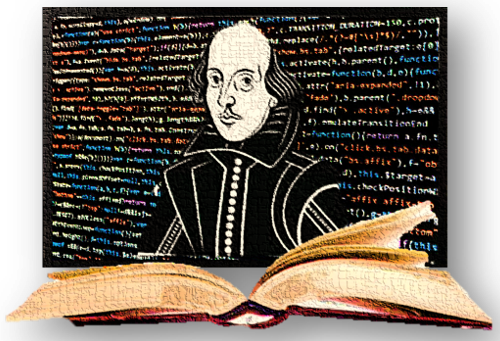
I have named this presentation Beyond Kahoot because this is the most usual response when students are asked in surveys which digital tools teachers use in class. My learning journey this year has definitely taught me that digital tools can be used to provide much richer experiences for students. I went into teaching thinking it was going to be all Robin Williams in Dead Poet’s Society but in honesty there’s a lot of routine and with Covid we’ve all ended up a bit frazzled. So, I decided that I needed to do something interesting and something that would also bring value and new skills to my teaching in the digital age. What has developed over the course of the year is that I have started to look at Digital Humanities through the lens of teaching and teaching through the lens of digital humanities, so I’m going to share with you some of the ways Digital Humanities has informed my teaching and future plans
One of the things we looked at early in the year which really informed my thinking and teaching was the difference between how texts are consumed now versus in the past. We looked at digitalized texts and digitized texts and for one of our term one assignments I began to consider how students experience texts today. In term one I took Digital Publishing and Editing and this led me to consider whether the medium students engaged with to learn actually mattered. This led to a small experiment with a class group to compare digital versus textbook learning which yielded some interesting results that I hope to explore in the future
Much of what we have done this year has informed my teaching and my thinking. Setting up our websites was a daunting task without a doubt, but early on I decided to focus on the Poetry side of my teaching for my website, to further explore how teachers can integrate technology into various areas of their teaching. I believe that teachers can use poetry writing in their classrooms to improve literacy among students and so it follows that using digital tools to create poetry can enhance digital literacy. The website is designed to be accessed by teachers and students to be used as part of classes. It is of course a work in progress, and I look forward to populating it over the summer
Another of the modules I took was Teaching and Learning and for this I designed a Digital Poetry Course for student teachers aimed at promoting creativity and literacy and digital engagement. This course features resources already in existence and ready to be used with teenagers, or as adult workshops or as part of writing festivals. The course plan is on the website as are some of the resources and lessons plans as a readymade digital poetry module. As with Shakespeare I have used and considered some of the methodologies in the context of my research proposal. In planning workshops, I drew on what we had been exploring in our courses, particularly the examples of sound poetry on Radio Nouspace. This connects to my planned research because in the new Junior Cycle, students are required to record themselves and to create oral presentations and performances. Mostly students have done this using phones. In surveying students for school planning, I found that given the choice the majority of students opt to engage with homework or schoolwork on phone, regardless of how many devices there are at home. So this has led me to ask the question of how and whether teachers consider this in planning AND whether publishers and creators in the field of education consider it in designing apps and digital versions of textbooks
Students are now being tasked in exams with reimaging texts in other formats and there is plenty that can be done with apps, and animations, even on basic PowerPoint that can enhance poetry, creativity, and literacy. For example, students all love a Word cloud! Writing poetry is a very personal thing – student who can fill pages with articles or stories are reluctant to pare their work back to the bones and reveal aspects of themselves, and sometimes even want to remain anonymous when we publish them. The theme of our school Yearbook this year is ‘A New Day Dawning’ and first years wrote poems which we made into a word cloud. You can see here the associations they make; some are predictable but others not so much. There are many apps which allow students to create word clouds but like so many resources they perform very differently depending on how students choose to access them.
I discovered by accident recently there can be learning for teachers in these visuals as well. Having used Voyant throughout the year – to look at language in Macbeth with LC1s for example – I decided to out some poems written in the style of Dickinson by LC students through Voyant. The first image here showed the poems’ themes (after ‘Hope’ is a thing with feathers) but something wasn’t right. I adjusted the stop words to exclude ‘And’ which features a lot in the poem and sure enough this became the most common words. However, I also excluded dashes – unfortunately so did the students! So, the next day as we looked at more of Dickinson’s poetry, I was aware I needed to focus more on punctuation. The visualisation had served as a means of formative assessment and had informed my future planning. This is a very simple example, but this angle is one I think connects well with my broader research and I intend to explore it further for the end of term project on tools.
During our look at Generative Art, we looked at various ways to manipulate photos and generate art with apps and AI – some of my younger students had fun on Daffodil Day putting creating digital art on their phones to visualize Wordsworth’s famous poem, again adapting and transforming text. This Digital Art Project is as yet a work in progress, but it features the setting of a poem to images and found sound. Given the finding that students will opt to create and learn on their phone regardless of other available options, I wanted to make it using the tools on my phone as much as possible, so the vocals and found sound were recorded on the phone, the photos are not yet complete but have all been taken and edited on phone, and the soundtracks were mixed using an app called Super Sound
I have talked a lot about how I’ve applied what we have learned to teaching and learning in the English classroom in this presentation and that is certainly my primary area of interest, but I also teach Music and one of last, but definitely most interesting things we did as part of the Digital Art class was to look at Sound art, and included in the resources was a link to an AI composition generator. This is definitely something that could be enjoyed by students who want to try digital composition but perhaps don’t read music such as the Leaving Cert Applied class I currently have, who will be working on compositions using this site after easter – you can see in the image how the melody line is manipulated using the cursor and the notes sound out as you place them. One of the first pieces I tried can be heard here!
All of this has led me to think about how students learn, using digital texts and resources versus traditional textbooks, and considering the emphasis in education on the digital, and on more self-directed learning on the part of students, what can be learnt from how students engaged with the traditional texts and methodologies and applied as we move forward.
Thank You
Bibliography
AIVA – The AI composing emotional soundtrack music (no date). Available at: https://aiva.ai/
Bikowski, D. (2018) ‘Interactive digital textbooks and engagement: A learning strategies framework’, Language Learning, p. 18.
Casey, J., 2019. Digital Shakespeare Is Neither Good Nor Bad, But Teaching Makes It So Humanities, 8(2), pp. 112.
Hall, L.A. (2019) “I Didn’t Enjoy Reading Until Now”: How Youth and Adults Engage with Interactive Digital Texts’, Research in the Teaching of English, 54(2), pp. 109–130.
Harvey, M.M. (2016). Recognizing similarities and differences between print and digital literacy in education. International Journal of Digital Literacy and Digital Competence, 7(4), 1–16.
Hayles, N.K. (2010) ‘How We Read: Close, Hyper, Machine’, ADE Bulletin, pp. 62–79.
Kahoot! | Learning games | Make learning awesome! (2013). Available at: https://kahoot.com/
Perloff, M. and Dworkin, C. (2009) The Sound of Poetry / The Poetry of Sound. University of Chicago Press
Prescott, A. and Hughes, L. (2018) ‘Why Do We Digitize? The Case for Slow Digitization’, Available at: Archive Journal – Archives and Special Collections in Higher Education
Radio Nouspace > Research > sound poetry (no date). Available at: http://radionouspace.net/research/soundpoetry/
Rockinson-Szapkiw, A.J. et al. (2013) ‘Electronic versus traditional print textbooks: A comparison study on the influence of university students’ learning’, Computers & Education, 63, pp. 259–266
Strickland, D.S. and Strickland, M.R. (1997) ‘Language and literacy: The poetry connection’, Language arts, 74(3), pp. 201–205.
The Sweet Old Etcetera (no date). Available at: https://collection.eliterature.org/2/works/clifford_the_sweet_old_etcetera.html
Wiseman, A. (2011) ‘Powerful students, powerful words: writing and learning in a poetry workshop: Powerful students, powerful words’, Literacy, 45(2), pp. 70–77.
WOMBO Dream – AI Powered Artwork Tool (no date). Available at: https://www.wombo.art/
Voyant Tools (2003). Available at: https://voyant-tools.org/
